Vertical Trust Throughout the Chain of Command and its Impact on the Fight
Captain Chris Chavez
Trust is the glue that holds together a healthy and successful command climate. In my last piece I argued that trust between peer commanders is a combat multiplier, simplifying communications and allowing Mission Command to be executed as it is intended. “Mission Command,” says Brigadier General Patrick Donahoe, “rests on a bulwark of trust.” A healthy unit culture is one with trust between all commanders at different echelons. On a rapidly changing battlefield, carefully rehearsed plans routinely become obsolete at first contact. Heeding recommendations from subordinate commanders, who perhaps have a better understanding of how the fight is progressing than those in the Mobile Command Group, is often the key to victory. Without trust that runs vertically through the chain of command, a unit will be woefully unable to adapt to changing conditions on the ground and will ultimately fail.
For the 11th Armored Cavalry Regiment (Blackhorse), also known as the Donovian Army during National Training Center (NTC) rotations, this happens in nearly all battles with the Rotational Training Unit (RTU). Fighting technologically superior near-peer threats like Armored Brigade Combat Teams (ABCT) and Stryker Brigade Combat Teams (SBCT) means that the Blackhorse must maintain an extraordinary level of flexibility as a matter of course. The Brigade Tactical Group (BTG) commanders regularly solicit recommendations from the Mechanized Infantry Battalion (MIBN) commanders, and will change task organizations and points of penetration based on the information they provide.
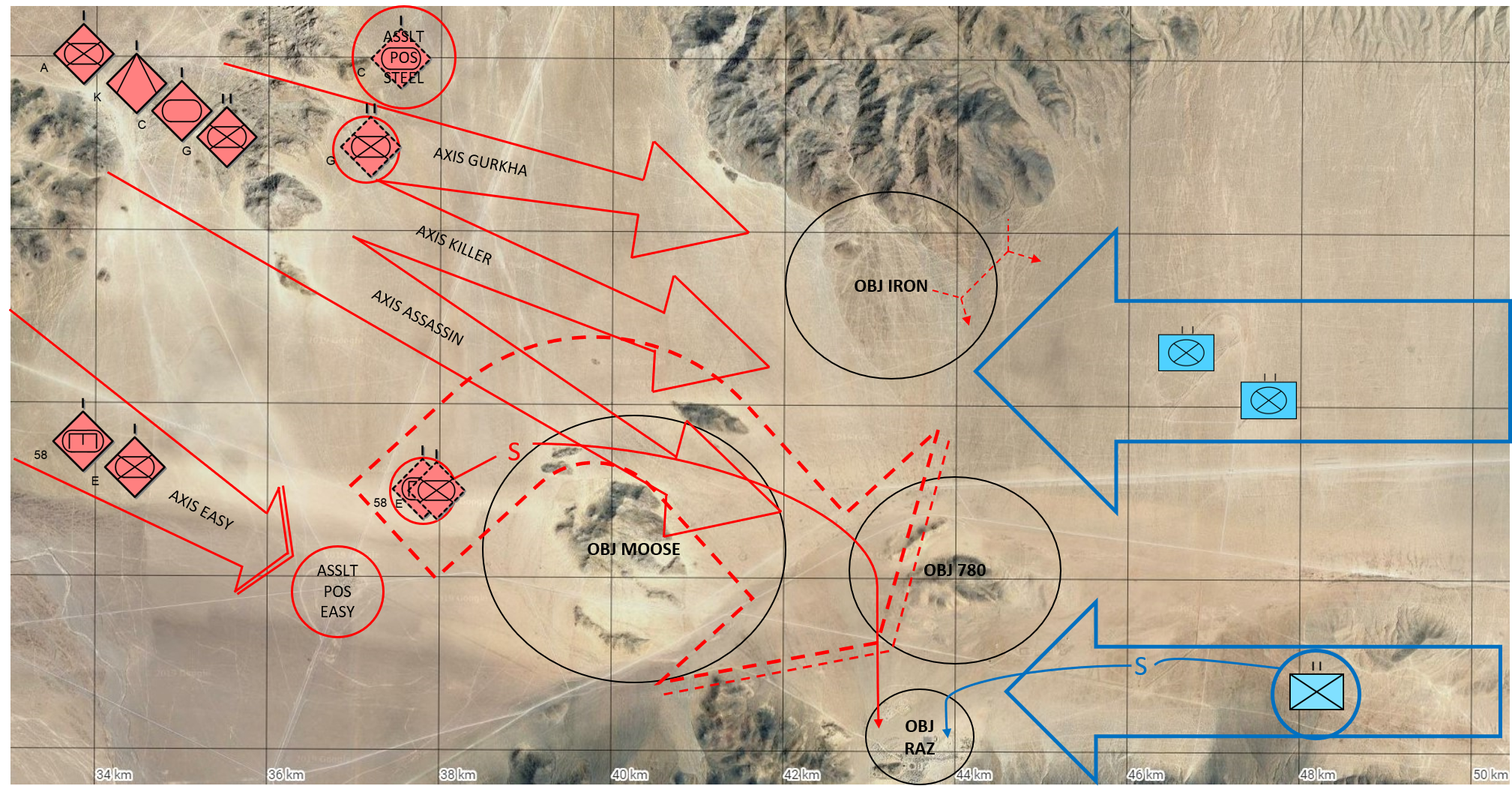
To illustrate this point, I will use a movement to contact fight at the National Training Center. The RTU was composed of a Cavalry Squadron, two Combined Arms Battalions (CABs), and a Light Infantry Battalion. The Cavalry Squadron spent the entire fight screening the east and northeast flanks of the main body vicinity Flagpole (now called Barasu, not shown on the maps below). The Donovian BTG, commanded by LTC Shane Celeen, was composed of one MIBN, two mechanized infantry troops, an anti-armor troop, an engineer company, and three armor troops (one of which was the BTG Reserve). One of the armor troops was sent as a feint through the northern corridor toward FLAGPOLE (in the far east), and is therefore not shown on the graphics below. Additionally, the BTG reconnaissance had been in heavy contact throughout the early morning hours, long before the BTG main body was permitted to cross the Line of Departure (LD) and unfortunately had been rendered combat ineffective.
The plan was for the two aggressors to have a meeting engagement in the central corridor, allowing the light infantry battalion to seize the city of Razish (OBJ RAZ). The BTG planned to seize key terrain running north to south. I was commanding Gurkha MIBN, tasked with seizing the Iron Triangle (OBJ IRON), with the follow-on task of establishing a support-by-fire position oriented on the two CABs approaching from the east. Cold Steel Troop (tank reserve), commanded by CPT Mike Gonzalez, would move behind Gurkha, and continue to their assault position. Killer Troop (anti-armor), commanded by CPT Dave Radke and Assassin Troop (mechanized infantry), commanded by CPT Mike Baker, would clear Hills 800 and 876 (OBJ MOOSE), continuing east to attack the two combined arms battalions. Easy Troop (mechanized infantry), commanded by CPT Mike Conforti, was the Decisive Operation (DO). They were tasked to move north of OBJ MOOSE then attack south to Razish (OBJ RAZ), seizing the city from the light infantry battalion. 58th Combat Engineer Company (Red Devil), commanded by CPT Dom Senteno, would follow and support Easy.
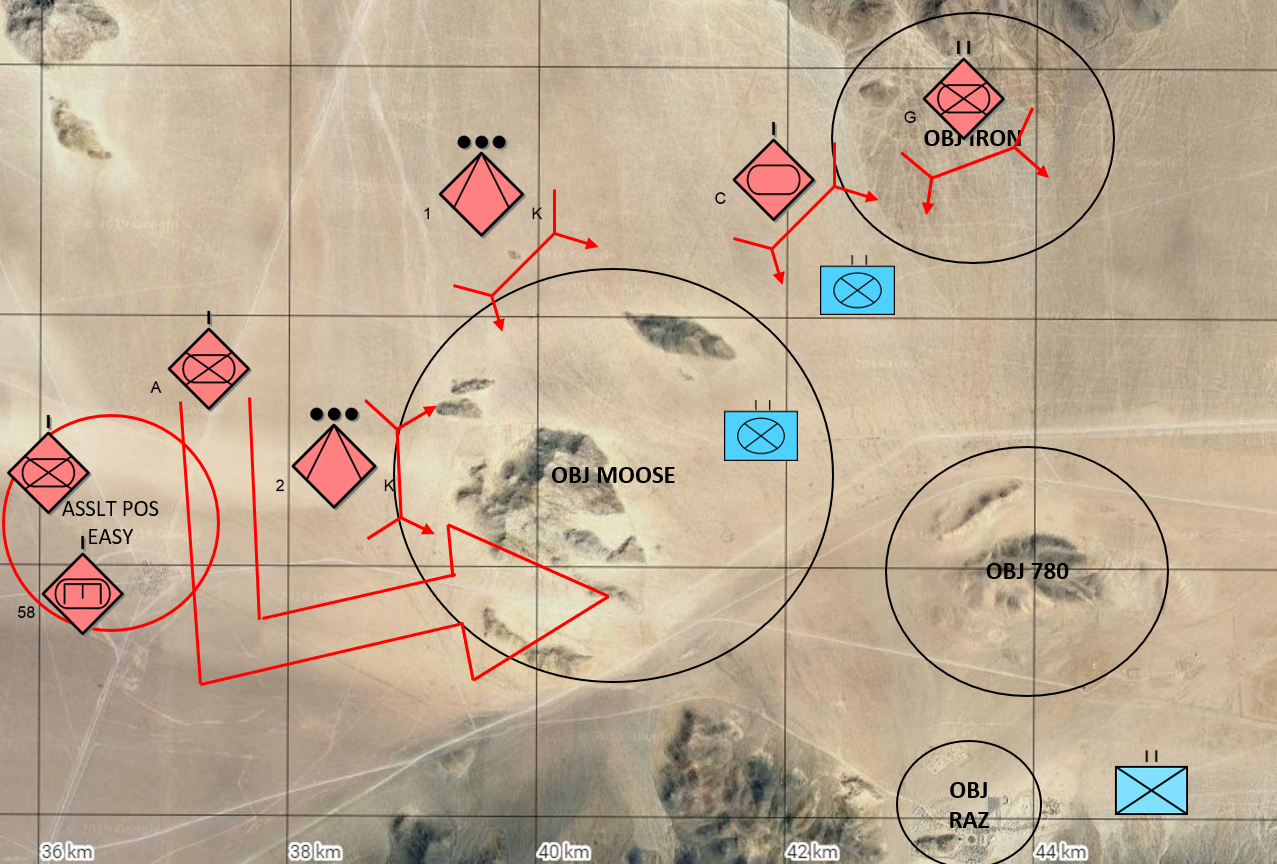
Because of the initial and unexpected success of the ABCT’s lead units which destroyed the BTG Reconnaissance, my fight to secure OBJ IRON took longer than initially intended. This resulted in the lead CAB beginning to penetrate between OBJs IRON and MOOSE. The Reserve commander, CPT Gonzalez, recommended to LTC Celeen that he be committed much earlier than initially intended to prevent the penetration. LTC Celeen agreed, and committed his reserve. This recommendation was a critical turning point in the fight. Cold Steel was able to stop the penetration and give Killer time to establish their support-by-fire position to destroy the enemy elements on OBJ MOOSE . As Killer Troop approached their maximum effective range to the approaching CAB, CPT Dave Radke recommended to the BTG commander that he split his element, establishing two support-by-fire positions on the north and south side of OBJ MOOSE. Again, LTC Celeen agreed. This would eventually allow Assassin to attack south of Hill 876 on OBJ MOOSE and prevent a penetration between OBJs MOOSE and 780.
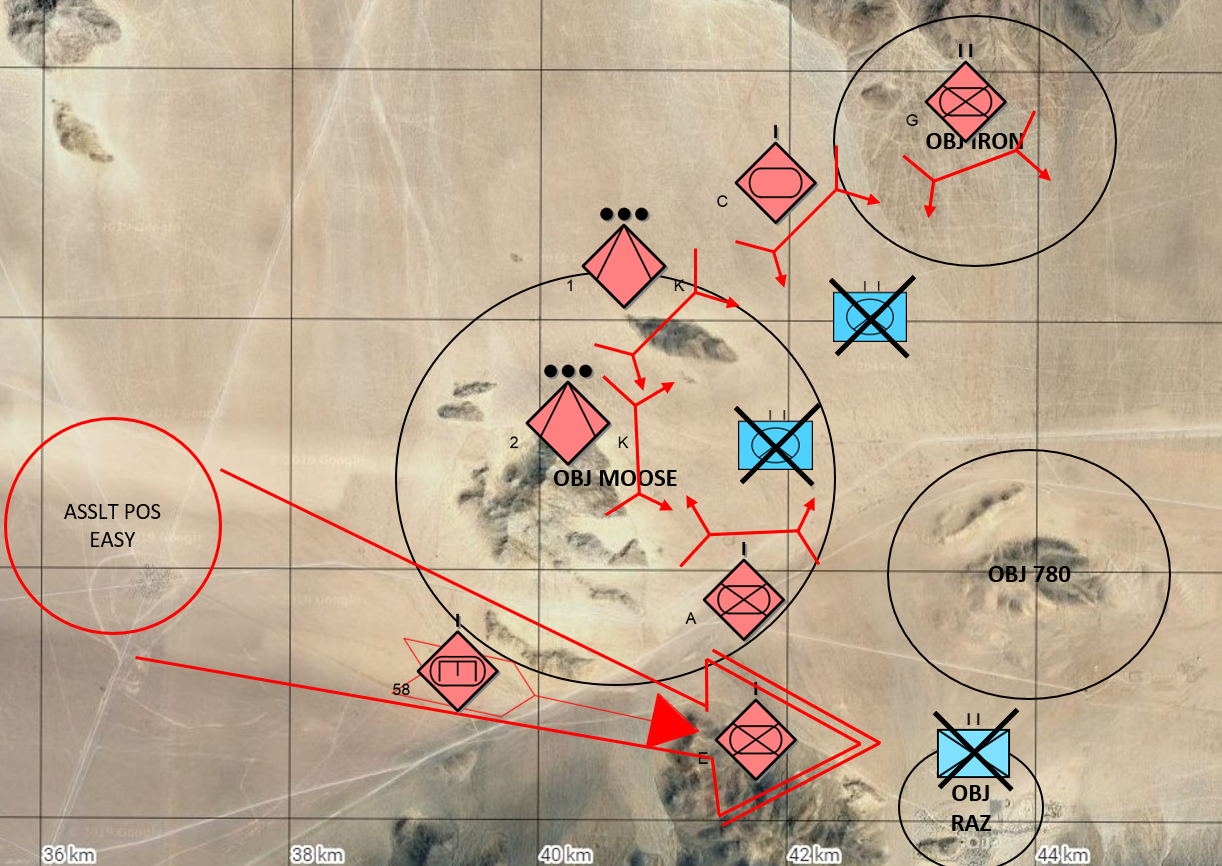
As Assassin attacked across OBJ MOOSE, LTC Celeen’s vehicle MILES had gone off, preventing him from moving to a good vantage point. He was only able to see the northern half of the fight. Because of this, he told CPT Baker to make the call to commit Easy and Red Devil to OBJ RAZ, and direct them on the best axis of advance. Once Assassin had cleared OBJ MOOSE, they were joined by the southern half of Killer between OBJ 780 and OBJ MOOSE, oriented north. This isolated OBJ RAZ from what remained of the two CABs, and opened a southern route to Easy Troop and Red Devil. It was at this time that CPT Baker recommended to the BTG commander that he commit Easy and Red Devil south of OBJ MOOSE, instead of the planned northern route between Hills 800 and 876. LTC Celeen committed the DO on the southern route. Along with the Bilasuvar Freedom Brigade (BFB), Easy and Red Devil destroyed the light infantry battalion and seized OBJ RAZ. The BTG crossed LD at 0900, and by 1145, the ABCT had been destroyed.
The BTG commander made three critical decisions that changed the course of the battle. All three had been recommendations made by Company/Troop commanders. The confidence that he had in the judgement of his subordinate commanders ultimately was the key to the BTG’s success. As Donovian commanders, we often saw units fight the battle they had planned, rather than fight the enemy in front of them. Even with this lack of flexibility, the RTU were sometimes still able to achieve some success against the Donovians, due to their numerical and technological superiority. The Donovians are not able to rely on such luxuries. To make up the difference, subordinate commanders are empowered and encouraged to submit recommendations to early and often during a fight. The use of trust, empowered subordinates, and a commander-driven climate has made the Blackhorse Regiment true practitioners of Mission Command. The agility that correctly executed Mission Command provides an organization, even one as out-numbered and out-gunned as the Donovian Army, is a true validation of the oft-misunderstood method of conducting military operations.
Corrections: I corrected the symbology for the Combined Arms Battalion. Also, Red Devil was commanded by CPT Dom Senteno at the time of this fight.
Copyright, UndercoverDonovian (Christopher Chavez), 2019. All Rights Reserved.
 Undercover Donovian
Leave a comment